Showing posts with label gaming. Show all posts

Friday, September 09, 2016

Learning with Minetest Part 3: Impact on the Students


This blog post is part of a series of posts exploring the concept of using the Minetest game as a learning platform in a primary school. Click below to access the other posts:

Learning with Minetest Part 1: Rolling out Minetest in Pre-Primary
Learning with Minetest Part 2: Activities and Aims
Learning with Minetest Part 3: Impact on the Students

Our Minetest experiment has ended for the moment. During the last month my Pre-Primary and Junior Primary students have been exploring the game Minetest in their IT time. This post will discuss the impact that Minetest had on the students.

Spatial awareness:
Students have had to learn how to use both the keyboard and mouse independently. Minetest has been an enormous motivator for children to become comfortable with manipulating the controls with both hands working independently of each other. I have been surprised by how quickly the reluctant children became able to move around the game world. Every child that played was able to complete the basic movement training within half an hour, even those who had never played Minecraft.

Social and emotional development:

Many discussions were had about in-game appropriate and inappropriate behaviour. Children asked permission when working in another person’s building space, collaborated together on activities and also dealt with situations that were not positive. Every class used a ruleset which emphasised appropriate behaviour and we used that as a framework to structure how we played the game. Multiplayer games are extremely common in this age range and much as we model correct choices and behaviour in the classroom, Minetest was a great space to model appropriate choices and behaviour in an online space.
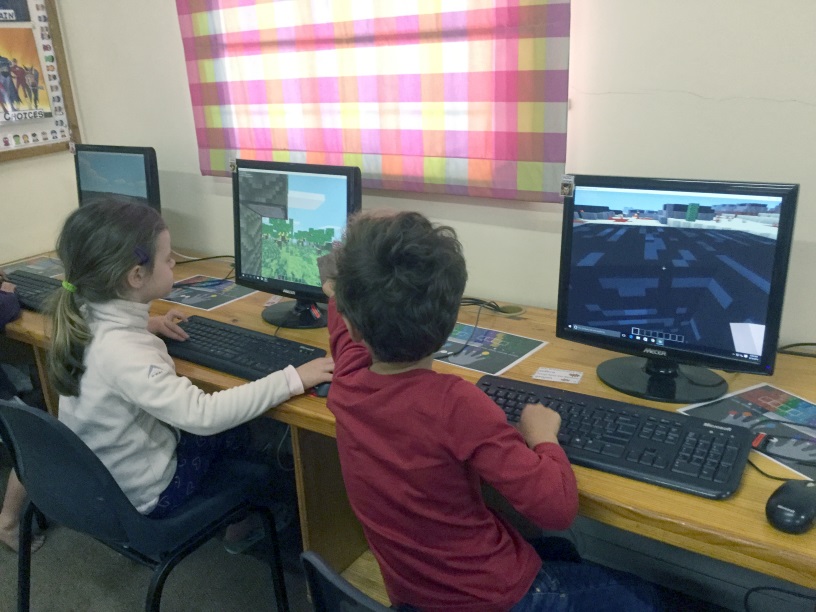
Opportunities for social modelling and development.
Problem solving and logical thinking:

Students navigated a 3D world space and created structures in it. They had to design what they wanted to build, gather resources for it, work out the different properties and mechanics of the game world and adjust their plans based on other builders. Some children began to investigate deeper mechanics such as creating tools to increase complexity of what could be built.

Digital skills (online safety):

All students discussed the difference between playing on the internet at home and playing Minetest in a school environment. We talked about safety when playing on the internet and the differences in the rules due to Minetest being played with a teacher. Much of the online safety discussion intersected with the social and emotional development aspects, as we talked about our behaviour in a game-space and how we could work together in a positive way. The Grade 3 classes talked about ‘trolling’ and ‘griefing’ (destructive/abusive behaviour) in online games and what we could do about it.

Summary:

Even though we have only ran Minetest as a pilot for 1 or 2 sessions per class, I the students developed a lot of key skills. Some of these were deliberate aims, such as digital skills and online safety, but many developed that I hadn’t considered before running the game:

Areas of the JP Technology Skills Checklist 2016 (Grade 3) that were developed using Minetest:
  • Interface
    • Mouse - 
      • Left, right and double click
      • Scrolling
      • Using hand/wrist to move mouse instead of entire arm
    • Keyboard - 
      • Functions of enter key and spacebar
      • Improving typing and keyboard fluency
  • Internet and research
    • Collaboration using technology
  • Digital skills (online safety)
    • Safe browsing: inappropriate websites, advert and pop-up navigation
    • Personal information safety, nicknames and login names - who needs to know?
    • Collaborating productively in an online space, how to handle conflict in a shared space
    • Cyber-bullying, appropriate behaviour online
Minetest is a highly engaging platform for student learning.
Minetest is a learning tool that is highly motivating for children because it mimics many gameplay elements of the popular Minecraft game. Minetest is appealing as a teacher because much of the uncertainty of online play has been removed, we only run our game within the computer lab. Because of this, it allows Minetest to be available to use to pursue learning goals. A 3D world space where the students can create their own structures makes it an ideal place to explore perimeter and area. The cube-shaped blocks allow for construction challenges or counting games. Schools around the world have used Minecraft in all areas of their curriculum and Minetest can work in a similar role.

If Minetest was used again in the computer labs I think that I would see it’s value as a learning tool increase now that most children that I teach are comfortable with the basics of playing the game.

I hope that you enjoyed this series on using Minetest. Please feel free to contact me on Twitter (@moniquefranzsen) to chat about using games for learning.

Previous - Learning with Minetest Part 2: Activities and Aims

Thursday, July 14, 2016

Game Review: Everybody's Gone to the Rapture

Game Review: Everybody's Gone to the Rapture
Developers: The Chinese Room

Welcome to Yaughton.
As someone who grew up in the UK, Everybody's Gone to the Rapture feels just like being in a Real English Village. The train station with uniform signage. It always interested me as a child that no matter what train station you went to, they always looked the same. The rainy caravan camp with scheduled activities. The pretty surroundings filled with people with insular, close-minded views. Two pubs and a church within walking distance but not a whole lot else going on. The Keeping Up Appearances houses, complete with slim white telephones. People still being considered outsiders or 'blow-ins' because they've only been living there for 1 or 2 generations... I've had authentic experiences of pretty much all of these things!

Hop on the train to Yaughton

The main story is a good scene-setter, there is a big ominous observatory near the village and we experience events surrounding two of the scientists that work there. It's a pretty straightforward sci-fi plot, and I'll always root for a decent sci-fi story. The real enjoyment for me, though, came from piecing together the inhabitants of the village, their relationships with each other and their trials and tribulations. Despite it being set in a different decade, I was often reminded of J.K. Rowling's adult book, The Casual Vacancy. Both this game and Rowling's novel are character studies, where you slowly figure out how everyone is interconnected. I really appreciate that gaming has come so far as to be compared with literature, even if it's only by me.

The voice acting and music are fantastic, especially given the limitation of not being able to see the characters - all the character interaction that we experience is in flashback. Without even seeing Wendy I could start to picture her as an old, interfering biddy the longer that I listened to her voice. Rhys and Rachel stood out as those rare younger folk of the village and I enjoyed their side-story immensely. They have some great choral music that seems to play along with appropriate story triggers, the music elevates certain important scenes to make them quite poignant. The emphasis on audio to tell the story reminded me of the tradition of excellent radio plays, where the acting needs to be that good so that the listener can tell what's going on. On reflection, I actually listened to Rowling's The Casual Vacancy as an audio book, with an excellent narrator voicing the characters. This is why EGttR and that novel both mirror these themes for me. Kudos to the voice artists and sound team, they really made the game a cut above the rest.

There is a fine old windmill on the hill overlooking Appleton's Farm.
Glowing balls of light

You are shown around the village by a moving, glowing ball of light, which was problematic at times. At one stage my ball of light got stuck in a hedge, leaving me on my own to hopefully trigger the right story-sequences, which are proximity-based. In the final section all of the voice-notes that were supposed to trigger just didn't, leaving the whole thing far more eerie (to be fair, I didn't realise there was supposed to be commentary on what I was seeing until reading forums after but I would have preferred the full experience). In certain sections I wandered around fine and hit the correct story beats, but in one or two places I sadly had to resort to a guide to complete that area's story. Adding some mechanical, game-y elements like objectives, a mini-map or waypoints certainly would have reduced my confusion. Unfortunately, doing this would probably have taken away from the mystical element of the glowing orbs.

The picturesque village and surrounds are absolutely beautiful. I was going to just grab some screenshots available online to demonstrate this but the idea of jumping back in to the game to take my own was exciting! For anyone that really enjoys taking an in-game walk and seeing the sights, EGttR has corn fields, shady forests, windy footpaths and more for you to explore. Gaming tourism at it's finest. If you have a decent rig then the game will be even more stunning, I was only able to play on lowish settings.

Stop by the village church.
Walking simulators?

Walking simulators is the label given, sometimes disparagingly, to games like Everybody Goes to the Rapture. The aim of the game is, yes, to walk around. You stroll around the game and interact with things, usually such as books or audio recordings, which helps unfold a story about the place that you are exploring. You don't get a weapon, which in a first-person video game is near-standard. You don't even get to jump or run very fast. Wikipedia calls EGttR a first-person adventure art game, which is a more appropriate moniker.

Some gamers turn up their noses at the 'art' tagline, saying that games that are trying to be art are pretentious:

"Games are supposed to be fun!" 
"There's supposed to be enemies!" 
"You're supposed to shoot things!" 
"You're supposed to level up!" 

Some of these statements I've found to be less true than others. As someone who rates narrative as the top thing I care about in a game, walking simulators are fantastic. I found that wombling around Yaughton and piecing together a narrative quite fun. If you're the kind of gamer that wouldn't enjoy that, well, just keep on walking.

As someone who has become a fan of of walking simulators, EGttR was unfortunately more like a crawling simulator. The walking speed is incredibly slow. The devs have released a post explaining that there was actually a run button, which I hugely appreciate them writing - it had been forgotten to be emphasised at release, causing some reviewers to really slam the game. Even with the run button, though, I found the default speed entirely too slow. To run you have to hold the key down which becomes tiresome. I understand the developers not wanting anyone to ruin the experience by bunny-hopping around the idyllic English countryside, as we tend to do in first-person titles, but I had to resort to using Cheat Engine to change the movement vales to something a bit less lethargic. They do prevent you running near important story areas, which I respect, in order to make sure you aren't missing anything.

Barbara will be able to help you at the surgery.
So why bother?

How is playing this game better than reading a book or watching a movie with the same premise? This is a common criticism leveled at walking simulators, and I think it's a genre that game developers are getting better and better at exploring. During my own play-through I did grumble about the shortfalls above, but I have now gone on to write this quite robust review. The game made an impact on me. Despite some mechanical reservations, I really enjoyed my time with EGttR. The atmosphere was unique and authentic. When I stepped into the access tunnel near the end, I could almost smell the rainy, cold smell of a similar place from my childhood. I just wish that you could explore more of it - some of the houses are explorable but some are not, leading to some time wasting.

The train station for Yaughton and Tipworth.
I suggest you play Everybody's Gone to the Rapture if you want to be immersed in the sights and sounds of a trip to the 1980's village of Yaughton. Don't forget to pack your wellies.

Thursday, June 23, 2016

Making Games in Scratch with Junior Primary


This post marks the end of an 11-week adventure. For the last couple of months I have been running a Coding Club for a group of 8 and 9 year olds. I wrote briefly about this in May but I thought that a more comprehensive wrap-up post would be fun for me and formative for you.

At our school we are lucky enough that each week we have some time set aside for Clubs. In club time our teachers host a variety of interesting, hobby clubs that our Grade 2s and 3s choose from voluntarily. It's a great exercise in student choice, that they don't have to choose an activity based just on what their friends are doing. We encourage them to choose an activity that is something that they personally would really like to do.

My eager bunch of coders had a mixed background - some had participated in Coding Club last term, some had taken part in the Hour of Code we did last year and some had never done any coding before. They were incredibly enthusiastic, particularly because I had framed our club around making games.

An example of some Scratch code created by one of my Gr 3 students.
All About Scratch

We used a freeware program called Scratch for our club. In case you haven't heard of it, Scratch is a hugely popular program where click-and-drag blocks are used to create instructions. It's very kid-friendly even though what you can create can get quite sophisticated. I had never learned coding before becoming a teacher and Scratch is a great introduction to the concepts behind coding, Coding has method and logic attached to it, and Scratch teaches that using method and logic can produce art, games, puzzles and even more. Coding has really become a type of 21st century literacy and Scratch propels that form of literacy forward.

CS First is a fantastic website that creates entire Scratch coding courses around themes. Our limited bandwidth means that I couldn't use the CS First built-in courses that function with the Scratch online site, so I used their course materials and an offline version of Scratch. Click here for instructions and links to what you need to get Scratch running offline. Our coding club was built around the great Gaming module on CS First. Each week I would take the group of students through a Scratch template projected on the board and demonstrate what coding blocks we would be using for that lesson. Then I let them loose on their desktops, sometimes in pairs or on their own depending on the activity.

This is what the Scratch platform looks like in action.

The Benefits of Using Scratch at a Junior Primary level:

I was incredibly impressed with the focus that this group of kids had. Despite their young ages, they managed to grasp the outcome of what I was steering them towards and really went for it. I learned along with them as we created:
  • a racing game for two players
  • a space-themed maze game
  • a platform game where we had to program x/y co-ordinates (!)
  • a bunch of other wacky and weird experiments
A sample of my students' creations.

The Challenges of using Scratch at a Junior Primary level:

There were very few challenges that we found. The offline version worked well and was very stable. 

Navigating file structures: We were able to save our projects into our local drives and retrieve them, and though some of my students still struggle with a Windows file structure we managed fine.

Reading: Literacy levels could be a barrier to enjoying Scratch because although the blocks are colour-coded the students still had to read the functions of the blocks. Using Scratch enhanced my students' vocabularies with words they were not using before like degrees, co-ordinates, sprite, percentage, function ... the list goes on! Coding was so fun that it was great motivation to tackle any tricky reading required.

Expectations: When explaining the concept of coding to my students, many wanted to immediately create Minecraft or Clash of Clans. It took a bit of work to get them to have realistic goals that they could achieve in a few sessions. Once they got the feeling of what they could do with Scratch, they regained their enthusiasm and really started to experiment.

Coding to create a magic spell!
At the end of our last session I awarded certificates to all of the students who took part. They received them with such genuine glee that it really made my day.


I would highly recommend Scratch for anyone who wants to introduce coding to primary-age children. It's offline client really saved us because so many amazing online tools are just not reliable for us yet due to our limited bandwidth. My students loved their creations and will now often choose to play on Scratch during free-time during IT time.

Monday, June 18, 2012

Gaming and Learning

Now, gaming and learning is a huge topic for me. I'm an educator (to be), and an avid gamer. In addition to the stigma that gaming receives from the 'mainstream' community, I am also a woman. Female gamers receive additional stigma from the 'mainstream' gaming community, which is ridiculous. Despite this vicious cycle, I still consider myself a proud gamer- no matter what anyone else thinks about it.

While researching for my essay on behaviourism as motivation, I went back to the topic of gamification. Gamification is the use of game design techniques or mechanics to enhance non-gaming contexts- such as school. There are a lot of naysayers about 'turning education into a game' and how students already spend enough time gaming at home. The truth is, elementary schools already use forms of gamification in their classrooms. Do all of your work? You get a sticker. Fill up your chart? You get a certificate. These response-reward pairings are basic behaviourism, so why not develop it further and take it beyond simple psychology? There is a reason why 400 million people play online social games with only virtual rewards. Gamification can satisfy human needs, such as rewards, status, achievement, self-expression, competition and altruism. It can become a valuable tool for developing intrinsic motivation in students, by using extrinsic motivation to start them off.

A good book on the subject is The Multiplayer Classroom: Designing Coursework as a Game by Lee Sheldon. He discusses using games as frameworks for delivering the content to students. Instead of "writing an essay" you can "explore". Instead of taking a test you can "complete a quest". The hope is that using the same kind of strategies which make games compelling can also cause the classroom to become even more compelling. 

Gabe Zichermann at TEDxKids discussing gamification.


John Hunter at TED 2011 discussing the World Peace Game.


I came across another fascinating project while on the hunt for gamification strategies- WoW in School. They are a group of educators who have created an after-school programme around World of Warcraft. Aimed at middle school students, it uses the medium of MMORPG as well as Tolkien's The Hobbit to improve language arts- all while following their national guidelines. I think it's brilliant, especially since I'm main healer for our guild's second raid team...Their guidebook is here if you're interested.

While my future little kidlets will most likely be between the ages of 6-9, I think that gamification concepts can still apply- even at that age. I was always a fervent gamer, even at that age (and younger!). It is the exact age-group which already uses behaviourist motivational techniques already, so I think that a motivated teacher could make a gamified Foundation Phase class thrive- see Gamification, your first grade teacher was onto something.

Wednesday, November 23, 2011

Slow Cooking and Holiday Plans

I was lucky enough to receive a slow cooker a few months ago as a present. While I love it, I haven't really done much more in it than stews and soups- though don't get me wrong, I love my stews and soups. It has taken me all this time, however, to realise that many people call a slow cooker a Crock-Pot. This is all about branding, a specific type of slow cooker brand is Crock-Pot and, much like Xeroxing or Pritt-Stick, the name has stuck. I googled "Crock-Pot" instead of slow cooker one evening and wow! Loads of results for delicious, simple recipes.

Recently, I stumbled on to Stephanie O'Dea's wonderful blog. She tried out a slow cooker challenge: to use her Crock-Pot every day of the year, for an entire year. And she did it! I admire her because she not only created recipes of her own, but wasn't afraid to post about her failures from that experiment. From her collection, I have tried out the five-layer brownies (twice!) and the brown sugar chicken recipes. Both have turned out super delicious, and I'm looking forward to using the slow cooker a lot more.When I go across the country to visit my family, I'm hoping that my boyfriend will pick up where I've left off with the slow cooking and he'll be a crock-pot master by the time I return!

According to the Official Google Blog, they are planning on phasing out Google Friend Connect (which Blogger currently provides a plugin for) and instead expecting users to use G+ instead for their connectivity. I'm all for this, when I set up my blog I was rather confused about the Friend Connect feature and hope that merging that function with G+ will make things smoother for everyone.

I have now finished my final undergraduate exams and am enjoying the long-awaited downtime. I haven't heard any response from the Education Faculty about the status of my application to PGCE- everyone I know who has applied has heard something so it is pretty frustrating but I'm trying to stay positive. Skyrim has just released, along with Saint's Row 3, so mostly I am gaming. While I was expected to become hooked by Skyrim, Saint's Row 3 has really surprised me. I haven't played any of the previous Saint's Row titles, but I hear that this new release has removed (some of) the crudeness. Though I haven't put a lot of time into it yet, it feels like a worthy successor to GTA: Vice City, which I adored about 5/6 years ago.

I'll be with my family for almost a month, on holiday, so I'm starting to decide what forms of digital entertainment I'll be taking with me. Daggerfall (fully optimised for XP with all the patches added in) has been installed on my netbook, though I'm unsure how to actually play it. It's one of the mega-old Elder Scrolls games, Skyrim's great-grandfather. Rock, Paper, Shotgun recently did an article on it which intrigued me and so I thought I'd give it a go.

During the holiday I hope to:
  • Socialise with friends
  • Catch up with family
  • Have a birthday celebration that everyone enjoys (including me)
  • Get through the Early Years teaching videos that I have
  • Read many books/ebooks
  • Enjoy Christmas and assist in avoiding any personality frictions among those attending
  • Remember to blog here, just a little bit

Brown Sugar Chicken- yummy!